Fire Suppression
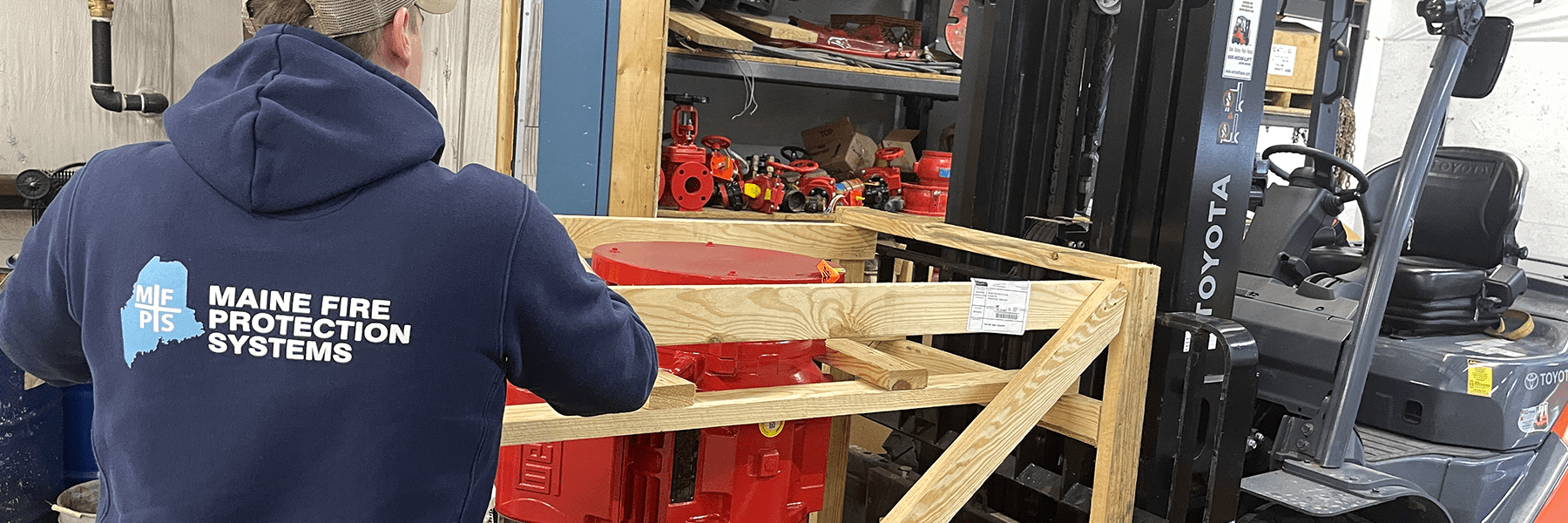
Fire Sprinkler & Suppressions Systems
Design | Fabrication | Installation | Inspection
Inspections
Our wide range of inspection services ensures that your safety systems are functioning properly and up to code. Inspections include:
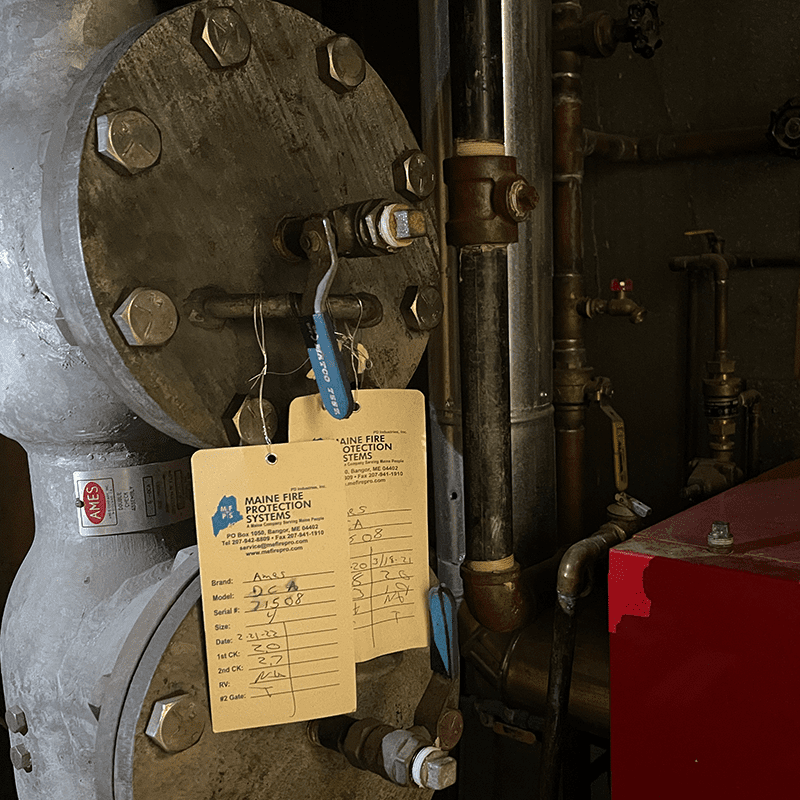
- Backflow Inspections
- Fire Extinguisher Inspections
- FIre Alarm & Sprinkler System Inspections
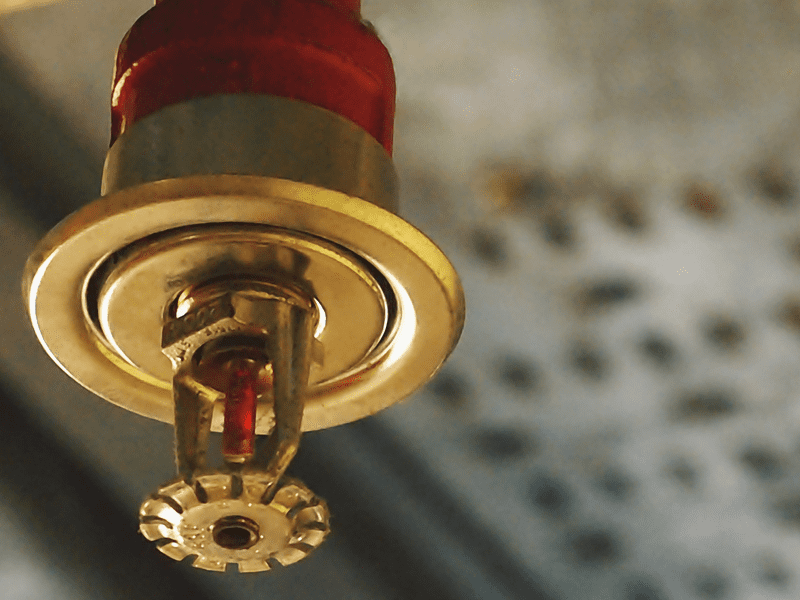

Fabrication & Installation
Our team is experienced in building, installing, inspecting, and servicing a variety systems for both commercial and residential needs, including:
- Dry Systems
- Wet Systems
- Anti-Freeze Systems
- Clean Agent Systems
- All Hazards
Engineered & Designed On Site
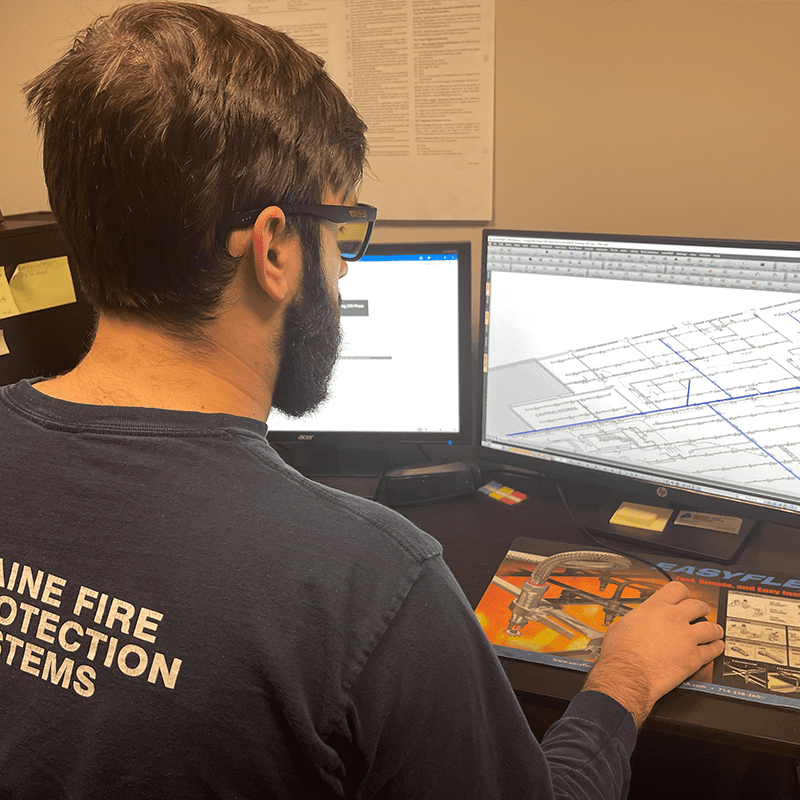
Maine Fire Protection Systems has an in-house team of certified, licensed design engineers. Our experience and expertise include:
- NICET certified
- UMaine School of Engineering Graduates
- State licensed RMS
Fire Pumps
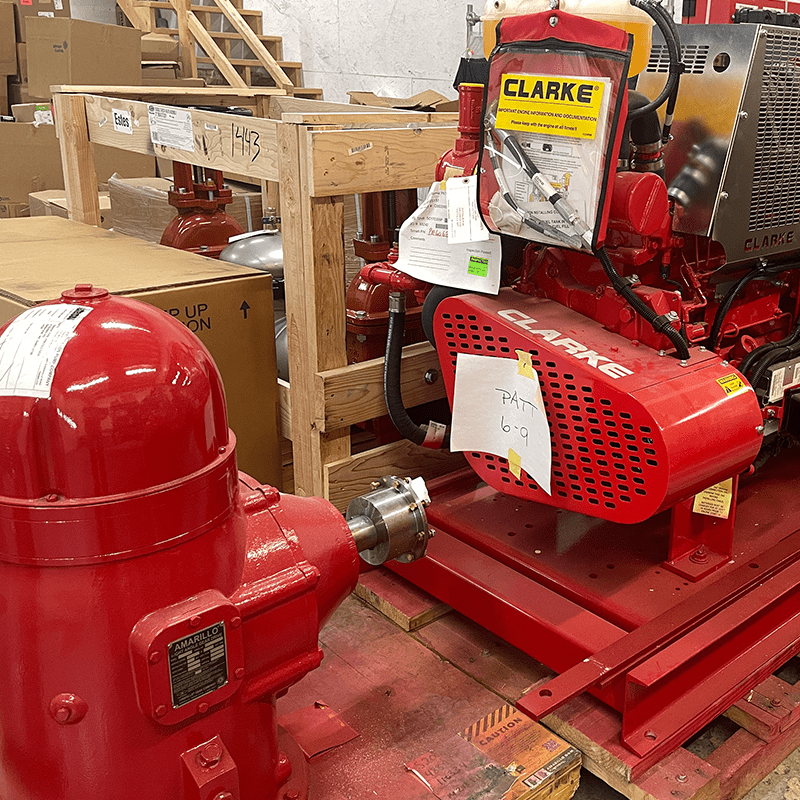
Maine Fire Protection Systems designs and installs fire pumps for fire protection systems in both vertical and horizontal configurations, as well as deep well systems.
- Electric or diesel-powered
- Controllers
- Flow meters
- Test headers and valves
Back Flow Prevention
We are licensed black flow inspectors and can provide annual service and inspections for the smallest residential to the largest commercial needs.
Answers to common sprinkler inspection questions
What happens during a quarterly sprinkler inspection?
A quarterly sprinkler inspection is your regular check-in to make sure the system is ready if you ever need it. Our inspector shows up at a previously scheduled time, heads to your sprinkler riser area, and walks through the system to confirm everything is operating as it should. If your sprinkler system is tied into a fire alarm panel, we silence the interior alarms so we don’t disrupt the building, then verify the flow alarms, visual strobes, and audible horns all trigger correctly. We check valves, gauges, and general condition. The whole thing is straightforward, but it’s the kind of thing you only know is working because somebody checks it four times a year.
Why do I need sprinkler inspections every three months?
Because the State of Maine requires it. Sprinkler inspections and testing are governed by NFPA 25, which the Maine State Fire Marshal’s Office has adopted as the standard for all water-based fire suppression systems. That standard sets the quarterly cadence, and every building owner with a sprinkler system is bound by it. Maine is a little unusual here. Most states leave fire code authority to the county or city, but we have a central authority at the state level, so everyone in Maine falls under the same standard. A handful of cities add their own requirements on top, but that’s rare.
Does NFPA 25 apply to the three-year and five-year services as well?
Yes. Everything falls under NFPA 25. The quarterly inspection is just one piece. Depending on what kind of system you have, wet, dry, preaction, or one of the preaction variants, NFPA 25 also lays out the three-year and five-year testing requirements. Each system type has its own specific protocol. We follow what the standard requires for the system you have on site.
Where do I get my inspection paperwork if I’ve lost it?
Call the office. We keep copies on file and can email a scan over right away. We’re in the middle of transitioning to a digital customer portal, and once that’s fully live you’ll be able to pull your own reports anytime you want them. In the meantime, a quick call gets you what you need. Quarterly sprinkler, and annual Fire alarm inspection reports are all on building reports, all customers should have a login to access there reports off of our website. If you do not know your login you can email or call the office and they can reset your log in.
Does it cost to get a copy of a report?
No. If you’ve lost a copy or need one resent, we scan and email it at no charge. Once the customer portal is live, you’ll be able to pull it yourself without even making the call.
Answers to common sprinkler head testing questions
Where do I find the report for sprinkler head testing?
Same place as your other inspection reports. You should have it in your email from when it was completed. If you can’t find it, call the office and we’ll resend it. Once your customer portal is active, it’ll be available there as well.
What if another company did the work and I want Maine Fire Protection to take it over? Can you pull those records?
The prior records would live with whichever company did the work, so you’d want to request them from that company directly. Under NFPA 25, the system owner is responsible for keeping records on file and providing them to the fire marshal. Think of it like your vehicle registration. The city isn’t the keeper of it. You are. The fire protection company is a third-party service provider that does the work and hands you the documentation. Once you have the prior records, we can pick up right where the other company left off.
What if another company did the work and I want Maine Fire Protection to take it over? Can you pull those records?
The prior records would live with whichever company did the work, so you’d want to request them from that company directly. Under NFPA 25, the system owner is responsible for keeping records on file and providing them to the fire marshal. Think of it like your vehicle registration. The city isn’t the keeper of it. You are. The fire protection company is a third-party service provider that does the work and hands you the documentation. Once you have the prior records, we can pick up right where the other company left off.
If a sprinkler head didn’t go off, why does it still need to be sent out for testing?
Because sprinkler heads have a shelf life. NFPA 25 requires periodic testing of sprinkler heads depending on the type. Some heads need to be tested at 10 years, some at 20, some go 50. It depends on whether you’ve got a quick response head, a fast response head, or something else. The heads are calibrated components, and over decades the fusible links or frangible bulbs can degrade, even if they’ve never been activated. Testing confirms they’ll still perform the way they were designed to.
How do I know what kind of sprinkler head I have, and how do I know how often things need to be serviced?
The information should be on site in your head box, which is the small cabinet kept near your riser with spare heads and a wrench. You can also visually identify heads if you know what you’re looking for. If you’re not sure what you have or what the service schedule is, that’s one we’re happy to come look at. A few minutes on site and we can tell you exactly what kind of heads you’ve got and when each piece of your system is due for service.
If one sprinkler head goes off, do they all go off?
That’s Hollywood, not real life. Only the heads that actually reach their activation temperature will go off. Every sprinkler head is individually calibrated and operates on its own. If you have a trash can fire in a bathroom, the head above that bathroom is the one that activates. The heads in the hallway, in the next room, across the building, those stay closed. Historically, most sprinkler activations involve just one or two heads. The one exception is an open-orifice deluge system, which is designed for every head to flow at once. You’d see those outside, over train cars or industrial hazards, and they’re the minority.
What sets a sprinkler head off?
Heat. Every head has one of two activating mechanisms. Some use a fusible link, a small solder connection that liquefies at a set temperature, releases a spring, and lets the plug blow out. Others use a frangible bulb, a glass bulb filled with a calibrated fluid. When the fluid reaches its activation temperature, it expands, bursts the bulb, and city water pressure pushes the plug out. Either way, the head stays closed until it personally gets hot enough to activate. No heat at that specific head, no water.
Does the sprinkler system work automatically?
Yes. Standard sprinkler heads are automatic. They sit quietly until heat reaches the activation temperature, and then that specific head opens on its own. No button, no switch, no human intervention required.
What should I budget over five years for system testing costs?
Honest answer: it depends on the system. A small CPVC life safety system running off city water with no pump or tank has relatively minor maintenance costs over five years. A new dry system in a factory is a different world. There’s a lot more testing, more components, and more that can need attention. If you’re planning a new install, we can walk you through realistic five-year service estimates for the specific system you’re considering, so you’re not guessing
Answers to common inspection report and paperwork questions
How do I get my inspection reports? Can you email or mail them?
Reports go out by email once an inspection is complete. If you need another copy, call the office and we’ll resend it. Your customer portal will be the permanent home for all of this once the transition is finished, and you’ll be able to pull any report yourself anytime.
Where are the notes and recommendations in my report?
They’re included in the report itself, organized alongside each inspection item. When you log into Building reports and pick your inspection, there is a navigation menu at the top of the report, select notes and recommendations and you will see the inspectors notes.
What does a red or yellow tag mean in my inspection report?
Red, yellow, and green are the three status indicators. Red tag means there’s a deficiency that needs to be repaired immediately. That’s a critical issue affecting the system’s ability to operate. Yellow tag is forward-looking It flags something that’s coming due, aging, or should be addressed soon, but it’s not a critical deficiency. Green means the item is in good working order. The red and yellow tags are the ones to pay attention to when you’re planning budgets and repairs.
Can you tell me what my deficiencies are in my inspection report?
Yes. Any deficiencies are called out by tag color in your report. Red tags are the immediate ones. Yellow tags are the forward-looking ones. If you want to walk through what each one means for your specific system and what the repair looks like, we can schedule a call or a site visit.
Are you able to send a copy of my inspection report to the fire marshal or my insurance company?
Our standard practice is to provide the reports directly to you, the owner. Under NFPA 25, the owner is responsible for maintaining those records and sharing them with the authority having jurisdiction or any third party like insurance. That said, if you need us to send a copy on your behalf, give us permission and we’re happy to handle it. We’ve done that plenty of times.
Answers to common back flow questions
Do you test backflows?
Yes. Both domestic and fire protection backflows, on both sides. Domestic backflow testing is actually a significant part of what we do.
What is a domestic backflow?
A domestic backflow is the assembly that protects your drinking water supply from contamination flowing back into the city system. If you’re on city water, you have one. It keeps water that’s used inside the building from siphoning back out into the public supply if pressure drops.
How often do I need my backflow tested?
Once a year. That applies to both fire protection backflows and commercial domestic backflows. Residential domestic backflows technically carry the same annual requirement, though enforcement on the residential side is lighter. Commercial is where the city stays on top of it.
Who has my backflow report if I’ve had one done?
We keep it on file at our office, and we forward a copy to the water district on your behalf as a courtesy. That’s how it works right now. Later this year, that flow changes. Reports will be uploaded to your customer portal, and you’ll send them to the water district yourself. In the meantime, if you need a copy, call the office.